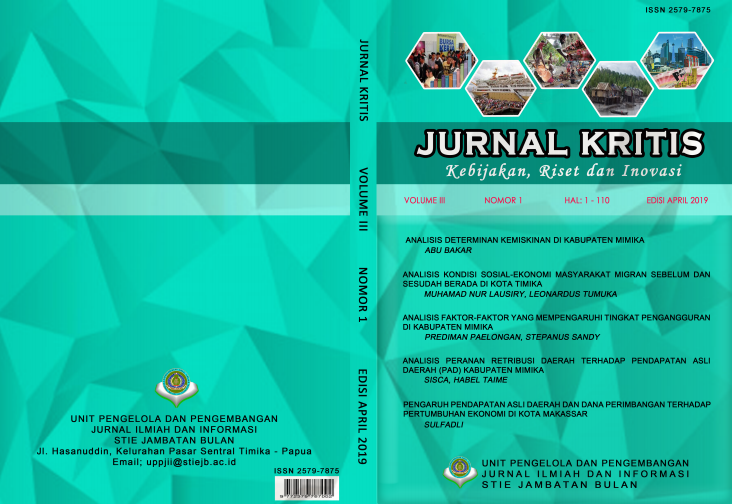
ANALISIS KONDISI SOSIAL-EKONOMI MASYARAKAT MIGRAN SEBELUM DAN SESUDAH BERADA DI KOTA TIMIKA
Keywords:
Socio-Economic Conditions, Employment, Income, Sign TestAbstract
The purpose of this study was to determine differences in the socio-economic conditions of migrant communities before and after being in the city of Timika. This study used a comparative and descriptive research method, where a comparative method was used to compare the socio-economic conditions of migrant communities before and after being in the city of Timika, while the descriptive method was used to describe the socio-economic conditions of migrant communities in the area of ??origin and after being in Timika. The type of data in this study is quantitative obtained from a sample of 300 respondents from migrant communities in the city of Timika. The sampling technique in this study uses a random sampling technique, which is part of probability sampling. The variable socio-economic conditions of migrants measured in this study are employment and income level, both in the area of ??origin, and after being in the city of Timika. The data analysis used in this study is the analysis of the sign test. The results of this study indicate that there are differences in the economic conditions of migrant communities in the area of ??origin after being in the city of Timika.
Downloads
Downloads
Published
Issue
Section
License
Authors who publish in Jurnal Kritis agree to the following terms:
- Authors retain copyright and grant the journal right of first publication with the work simultaneously licensed under a Creative Commons Attribution License that allows others to share the work with an acknowledgment of the work's authorship and initial publication in this journal.
- Authors are able to enter into separate, additional contractual arrangements for the non-exclusive distribution of the journal's published version of the work (e.g., post it to an institutional repository or publish it in a book), with an acknowledgment of its initial publication in this journal.
- Authors are permitted and encouraged to post their work online (e.g., in institutional repositories or on their website) prior to and during the submission process, as it can lead to productive exchanges, as well as earlier and greater citation of published work.(See The Effect of Open Access)
All rights reserved. This is an open-access article distributed under the terms of the Creative Commons Attribution-ShareAlike 4.0 International License
Licensed under  a Creative Commons Attribution 4.0 International License