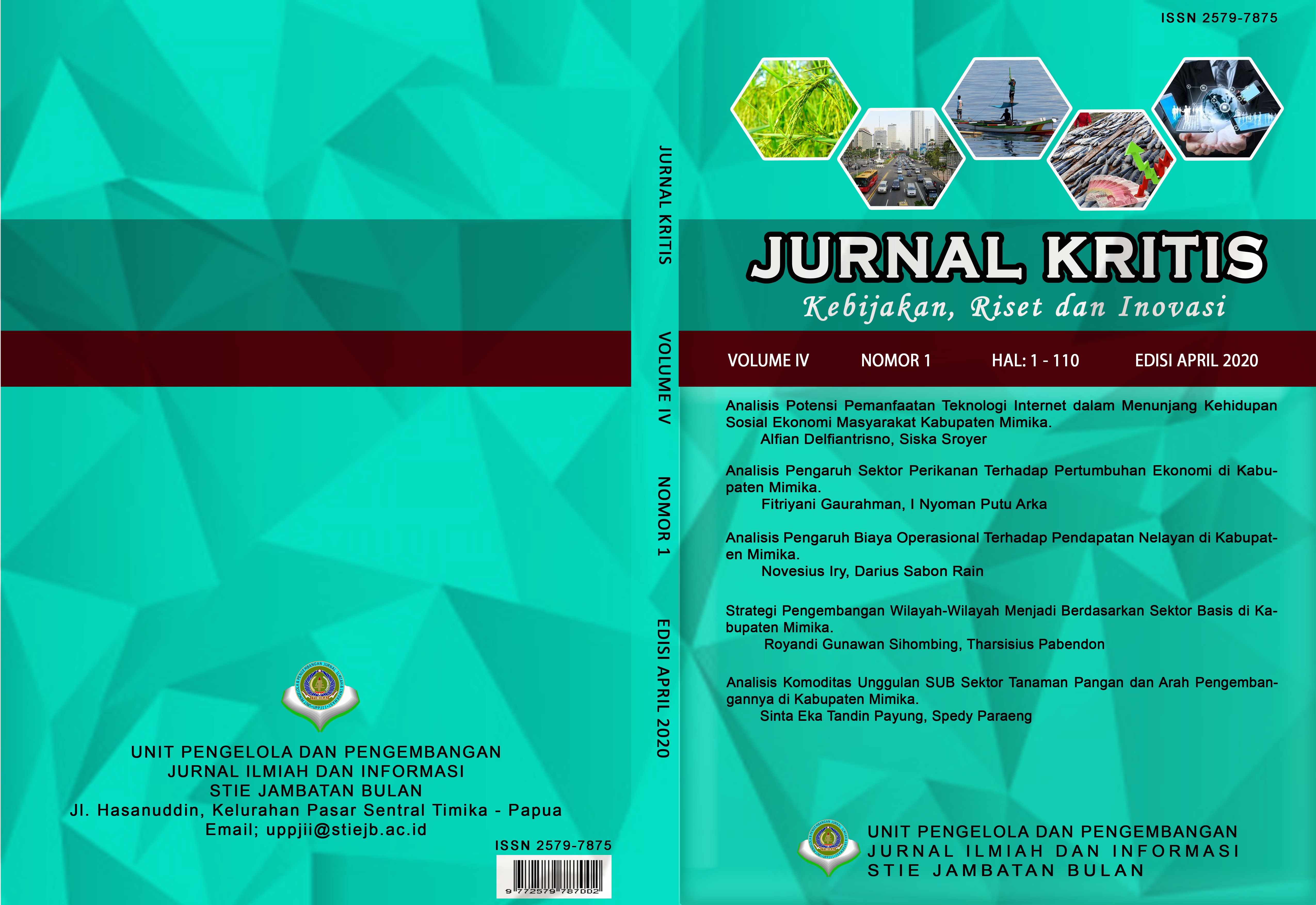
ANALISIS KOMODITAS UNGGULAN SUB SEKTOR TANAMAN PANGAN DAN ARAH PENGEMBANGANNYA DI KABUPATEN MIMIKA
Keywords:
Food Crops, Main Commodities, Development DirectionAbstract
This study aims to determine the leading commodities of the food crop sub-sector in Mimika Regency and to determine the direction of the development of the leading commodities of the food crop sub-sector in Mimika Regency. The approach used by researchers is a descriptive approach that aims to describe / describe the leading commodities in the food crops sub-sector and the direction of their development in Mimika Regency. The data collection technique used by researchers is documentation. The analytical tool used in this study is the Location Quotient (LQ) analysis and Differential Shift (DS) analysis in Shift Share Analysis (SSA). Based on the results of the LQ analysis, the leading commodities in Mimika Regency are corn, peanuts, cassava (cassava) and sweet potatoes (petatas). Whereas based on the results of DS analysis, corn commodities are directed at the East Mimika District, Kuala Kencana District and Jita District. Peanut commodities are directed at East Mimika District, Mimika Baru District and Kuala Kencana District. Cassava commodity (kasbi) is directed at West Mimika District, West Mimika District, Far West Mimika District, East Mimika District, Middle East Mimika District, Far East Mimika District, Kuala Kencana District, Agimuga District, Jila District and Jita District. Sweet potato commodity (petatas) is directed at East Mimika District, Kuala Kencana District, Agimuga District and Jila District.
Downloads
References
Arsyad, Lincolin. Ekonomi pembangunan. Yogyakarta : UPP STIM YKPN, 2004.
Arsyad, Lincolin .Ekonomi pembangunan. Yogyakarta : UPP STIM YKPN, 2015.
Arsyad, Lincolin.Pengantar Perencanaan dan Pembangunan Ekonomi Daerah. Yogyakarta : BPFE-YOGYAKARTA, 1999.
Dinas Pertanian.2018.Data Produksi Tanaman Pangan Menurut Distrik Tahun 2012-2017.Mimika Tanaman Pangan dan Holtikultura Kabupaten Mimika.
Keratorop, Marianus., Widiatmaka dan Suwardi. “Arahan Pengembangan Komoditas Tanaman Pangan Di Kabupaten Boven Digoel Provinsi Papua”. Jurnal Pengelolaan Sumberdaya Alam dan Lingkungan, ISSN 2086-4639, e-ISSN 2460-5824. Vol 6 (2), 2016: Hal. 142.
Kuncoro, Mudrajad Ph.D. Indikator Ekonomi. Yogyakarta :UPP STIM YKPN, 2013.
Meitasuci, Dzulfiana. “Kajian Komoditas Tanaman Padi dan Jagung dalam Mendukung Ketahanan Pangan di Kecamatan Sumbang Kabupaten Banyumas. Skripsi Sarjana, Program Studi Pendidikan Geografi, Fakultas Geografi Universitas Muhammadiyah Purwokerto, 2018, Hal.18.
Nurlina, Puti Andiny, Maulia Sari. “Analisis Sektor Unggulan Aceh Bagian Timur”. Jurnal Samudra Ekonomi dan Bisnis, P-ISSN 2089-1989, E-ISSN 2614-1523.Vol 10 (1), 2019: Hal. 26.
Pujoalwanto, Basuki. Perekonomian Indonesia, Yogyakarta: GRAHA ILMU, 2014.
Rasyid, Abdurrahman. “Analisis Potensi Sektor Pertanian di Kabupaten Kediri Tahun 2010-2014”. Jurnal Ekonomi Pembangunan, Program Nasional Pemberdayaan Masyarakat Pedesaan (PNPM). Vol 14, No.02, 2016. Hal 107.
Sukirno, Sadono. Ekonomi Pembangunan. Jakarta : Prenadamedia Group, 2006.
Tarigan, Robinson. Ekonomi Regional. Rev.ed. Jakarta: PT Bumi Aksara, 2015
Downloads
Published
Issue
Section
License
Authors who publish in Jurnal Kritis agree to the following terms:
- Authors retain copyright and grant the journal right of first publication with the work simultaneously licensed under a Creative Commons Attribution License that allows others to share the work with an acknowledgment of the work's authorship and initial publication in this journal.
- Authors are able to enter into separate, additional contractual arrangements for the non-exclusive distribution of the journal's published version of the work (e.g., post it to an institutional repository or publish it in a book), with an acknowledgment of its initial publication in this journal.
- Authors are permitted and encouraged to post their work online (e.g., in institutional repositories or on their website) prior to and during the submission process, as it can lead to productive exchanges, as well as earlier and greater citation of published work.(See The Effect of Open Access)
All rights reserved. This is an open-access article distributed under the terms of the Creative Commons Attribution-ShareAlike 4.0 International License
Licensed under  a Creative Commons Attribution 4.0 International License